Local Government Reform Proposal August update
Tauranga City Council has acknowledged that the community's preference for a locally led approach to local government reform may not be achievable following decisions by neighbouring councils not to proceed with proposals through the Government's Head Start pathway.
The Government's deadline for submitting Head Start proposals was 9 August 2026.
Tauranga City Council and Western Bay of Plenty District Council had been working towards a joint proposal for a single unitary authority for the Western Bay of Plenty sub-region as part of a wider Bay of Plenty reform proposal.
The councils participated in seven joint workshops and made progress on key issues raised through community engagement, including the allocation of debt and local representation arrangements within a merged council structure.
At a joint Council meeting on 6 August 2026, Tauranga City Council Elected Members voted 9-0, with one abstention, to support progressing the proposal. Western Bay of Plenty District Council voted 6-4 against joining the proposal.
Whakatāne District Council, Ōpōtiki District Council and Kawerau District Council submitted an application for the Eastern Bay of Plenty. However, Rotorua Lakes Council did not reach agreement on submitting a proposal and as a result, all the criteria for a Bay of Plenty-wide Head Start proposal have not been fully met.
The Government has indicated that local government reform will proceed, with the Head Start pathway intended to enable councils to develop locally led proposals. If the Head Start pathway does not proceed, local authorities may be subject to the Government's Backstop process, through which future local government structures would be determined by central government.
Current indications suggest this process could consider a Bay of Plenty-wide unitary authority. Council notes that this was not the preferred option identified through community engagement undertaken across the region.
Despite the proposal no longer meeting all Government eligibility criteria, Tauranga City Council has submitted the work completed to date to the Government. This is intended to support ongoing discussions and provide an opportunity to explore alternative options.
July 2026 update
Results from our recent survey on the future of local government show strong community support for change.
View full survey results (2.5mb pdf)
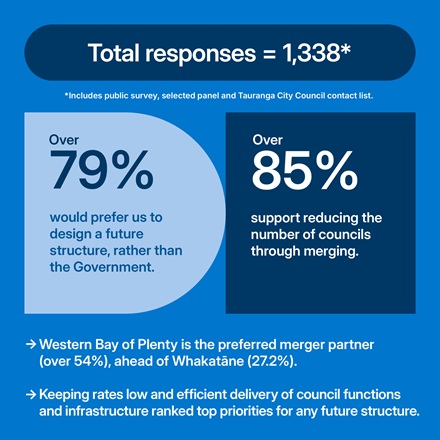
Over the coming month, we will be taking on board community feedback and continue to work with neighbouring councils, as we further develop options for how local authorities in our region could be structured in the future. Final decisions about submitting any potential proposal will be made before the Government’s 9 August deadline. We’ll keep you updated.
To hear more from Mayor Mahé Drysdale about the topic, you can watch this Q&A video session from 24 June on Facebook and our You Tube channel.
What is Simplifying Local Government?
The Government is proposing changes to how local government is structured, under its “Simplifying Local Government” work programme. Its aim is to simplify how councils are structured and governed and reduce the number of councils in New Zealand.
This would likely include councils working more closely together or combining. This could affect how decisions are made, how services are delivered, and how local communities are represented.
The Government has made it clear that if councils don’t put forward their own proposals through the ‘Head Start’ pathway it announced in May 2026, change will be imposed on us. This would involve a standardised, compulsory reorganisation ‘Backstop’ process after 2028.
Councils that wish to be part of the Head Start pathway have until 9 August 2026 to submit a high-level ‘outline’ proposal. While the proposal must be submitted by then, it will still need Government approval, and councils will then have until March 2027 to further refine any proposal into a full plan, which would take effect after the 2028 local elections.
The opportunity in front of us
Our Council’s preference is to help lead and design this change by submitting a Head Start outline proposal by 9 August, rather than have central government determine change for us further down the track.
We’ve been exploring options with neighbouring councils to consider how local government functions and services could be reorganised and what potential council structures are worth exploring further. We’re keeping an open mind about what’s possible, while making sure any proposal meets the Government’s criteria (set out below).
While timeframes are very tight, we want to share what we know so far, outline the options we’re considering, and understand what’s important to you. Your feedback will help guide us as we consider any changes and whether to submit a proposal.
Importantly, Tauranga City Council services continue as normal in the meantime. This is about future structure, not immediate service changes.